A design exploration for a web-based live streaming project built around WebCodec and custom HTTP transport.
Context: I need to build a web-based video conference that supports screen sharing.
Why Another Design?
In this post, I want to discuss a live conference architecture built on HTTP and WebCodec. By web, I mean technologies that run natively in the browser—no plugins, no native dependencies.
Live conferences are fundamentally about real-time audio and video. Behind the scenes, this involves:
- Networking — delivering data reliably (or timely) across the Internet
- Codecs — compressing raw media into efficient streams
- Quality control — adapting to bandwidth and packet loss
A typical multiparty meeting may adopt a mesh topology like this:
          Alice
         /     \
        /       \
       /         \
     Bob ------- Carol
In WebRTC, this is called P2P (Peer-to-Peer). It works well in theory, but in practice it introduces several challenges:
- Each peer must discover the other’s public IP and port via a STUN server
- If NAT traversal fails, a TURN server relays the traffic
- ICE signaling requires an additional server to exchange session descriptions
- Most WebRTC implementations do not reuse UDP sockets efficiently, leading to high resource consumption
WebRTC vs. SFU vs. RTSP/RTMP
A more scalable alternative is the SFU (Selective Forwarding Unit) pattern, where each client pushes its stream to a central server, which then forwards copies to all other participants:
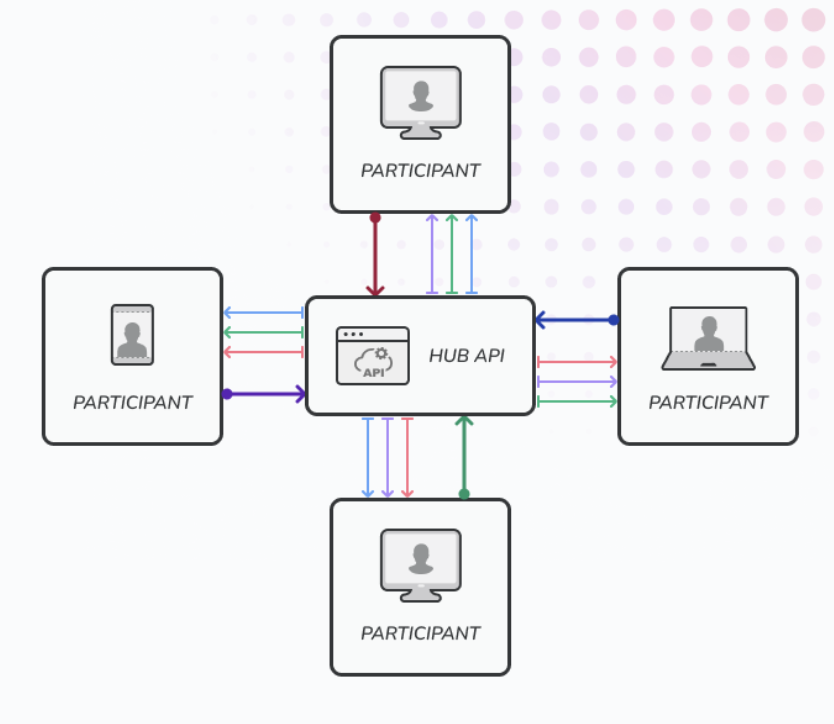
This is conceptually similar to RTSP/RTMP streaming, but those protocols are not allowed in browsers due to security restrictions.
To view RTSP/RTMP streams on the web, one common workaround is to remux them into HLS or MPEG-DASH—formats that the browser can play via <video> or MSE (Media Source Extensions). However, this approach comes with heavy costs:
- Multiple data copies — depacketizing RTP into raw H.264, then repacketizing into fragmented MP4. This increases latency and CPU load.
- GOP-level buffering — HLS/DASH require at least one full GOP (Group of Pictures) before playback, which typically adds 1–2 seconds of delay. This is unacceptable for interactive use cases like drones, cars, or teleoperation.
- Packet loss sensitivity — reordering or loss during remuxing can corrupt the output, requiring complex integrity handling.
So What’s the Current State of Web Media?
- WebRTC is powerful but complex (multiple servers, high socket usage, black-box internals)
- HLS/DASH is reliable but high-latency, suitable only for watching, not interacting
- WebCodecs (which we’ll explore below) is a new browser API that exposes codec primitives, giving developers fine-grained control over encoding/decoding
It seems there is no single “perfect” web conference protocol today—we either inherit from mature but heavy frameworks, or trade off latency and control.
Enter WebCodecs: A Developer-Friendly Codec API
WebCodecs is a game-changer. It exposes low-level video/audio encoder/decoder interfaces directly to JavaScript, without hiding them behind proprietary black boxes like WebRTC.
Examples are available here, and the codec support list is maintained here.
This gives developers the ability to:
- Encode raw frames from camera/screen capture
- Decode incoming streams at the frame level
- Build custom streaming logic—retransmission, prioritization, adaptive bitrate, etc.
Combined with modern web primitives like WritableStream, we have the building blocks for a fully custom media pipeline.
The Missing Piece: A Transport Protocol
We now have codec control, but we still lack a transport protocol tailored to WebCodecs:
- It must handle stream integrity, loss recovery, and reordering
- It should be HTTP-friendly (firewalls, load balancers, proxies)
- It should support fallback to TCP when HTTP/3 (QUIC) is unavailable
HTTP/3 + QUIC is ideal—it provides multiplexing, low-latency, and native stream abstraction. However, not all infrastructure supports it yet. So we need a fallback.
Proposed Design: HTTP + WebCodec + Intelligent Fallback
Our protocol supports both HTTP/3 (QUIC) and HTTP/2/1.1 with keep-alive as fallback. In case of head-of-line blocking over TCP, we can:
- Switch to a lower-quality stream
- Or open multiple TCP connections for different media feeds
A typical session might look like this:
                             SERVER
══════════════════════════════════════════════════════════════════════

                 +--------------------------------+
                 |     Media Scheduler (MTL)      |
                 |--------------------------------|
                 | Frame Window                   |
                 | Frame Database                 |
                 | GOP Dependency Graph           |
                 | Path Scheduler                 |
                 | Quality Controller             |
                 +--------------------------------+
                   │        │        │        │
         HTTP #1   │ HTTP #2│ HTTP #3│ RTCP-like
───────────────────┼────────┼────────┼──────────────
                   │        │        │
                   ▼        ▼        ▼
          TCP1          TCP2          TCP3          TCP4
══════════════════════════════════════════════════════════════════════
                              NETWORK
══════════════════════════════════════════════════════════════════════
The client side similarly maintains multiple TCP streams, each carrying a separate feed. A control channel (RTCP-like) handles feedback and retransmission requests:
══════════════════════════════════════════════════════════════════════
                              NETWORK
══════════════════════════════════════════════════════════════════════
          TCP1          TCP2          TCP3          TCP4

HTTP Conn1      HTTP Conn2      HTTP Conn3      Control Conn
     │               │               │               ▲
     └──────┬────────┴───────────────┘               │
            ▼                                        │
     +----------------------------------------------+
     |          Frame Reassembler                    |
     +----------------------------------------------+
                     │
                     ▼
          +-------------------------+
          | Receiver Window         |
          |-------------------------|
          |100 ✓                    |
          |101 ✓                    |
          |102 ✗                    |
          |103 ✓                    |
          |104 ✓                    |
          +-------------------------+
                     │
           Missing Frame Detector
                     │
                     ▼
             RTCP-like Feedback
                     │
                     ▲
       Request Frame102 via other TCPs
                     │
                     ▲
     Drop blocking TCP, starting new ones
This hybrid approach shares characteristics with QUIC + WebRTC, but remains lightweight and HTTP-accessible. It works well under moderate network conditions, but may struggle in highly lossy environments—choose wisely based on your use case.
Custom Frame Format: Tailored for WebCodecs
Traditional RTP packets are designed around UDP MTU (~1500 bytes), with complex fragmentation schemes for H.264 (e.g., RFC 6184).
For a WebCodecs-based pipeline, we want something simpler and more aligned with the browser’s expectations. The most critical piece is the codec configuration string defined in RFC 6381. For example:
const encoderConfig = {
  codec: "avc1.4d4028",
  width: 800,
  height: 600,
  framerate: 30,
  avc: { format: "annexb" }
};
This string tells the browser which codec, profile, and level to use. Our custom protocol defines four main frame types:
| Type | Name | Description |
|---|---|---|
vcnf |
Video Configuration | Codec init data for video |
acnf |
Audio Configuration | Codec init data for audio |
vfrm |
Video Frame | Encoded H.264/H.265/VP9 data |
afrm |
Audio Frame | Encoded AAC/Opus data |
Each frame is prefixed with a simple binary header, and multiple TCP connections carry different feeds. Video frames (vfrm) support fragmentation, so large IDR frames can be split across packets.
Here are the detailed packet structures:
vcnf — Video Configuration
+------------------------------------------------+
| SEP (Start of Frame)                            |
+------------------------------------------------+
| BoxName = "vcnf"                                |
+------------------------------------------------+
| PayloadLen                                      |
+------------------------------------------------+
| Width (uint16)                                  |
+------------------------------------------------+
| Height (uint16)                                 |
+------------------------------------------------+
| CodecLen (uint16)                               |
+------------------------------------------------+
| RFC6381 Codec String                            |
+------------------------------------------------+
| ExtraDataLen (uint32)                           |
+------------------------------------------------+
| AVC/HEVC Extradata (e.g., SPS/PPS)              |
+------------------------------------------------+
acnf — Audio Configuration
+------------------------------------------------+
| SEP                                             |
+------------------------------------------------+
| BoxName = "acnf"                                |
+------------------------------------------------+
| PayloadLen                                      |
+------------------------------------------------+
| CodecType String (RFC6381)                      |
+------------------------------------------------+
| Codec Extradata (if any)                       |
+------------------------------------------------+
afrm — Audio Frame
+------------------------------------------------+
| SEP                                             |
+------------------------------------------------+
| BoxName = "afrm"                                |
+------------------------------------------------+
| PayloadLen                                      |
+------------------------------------------------+
| FEED (uint32) — feed identifier                |
+------------------------------------------------+
| Sequence (uint32)                               |
+------------------------------------------------+
| Timestamp (uint64) — media time                |
+------------------------------------------------+
| FrameID (uint64) — unique frame ID             |
+------------------------------------------------+
| Duration (uint32) — sample duration            |
+------------------------------------------------+
| Payload (encoded audio data)                   |
+------------------------------------------------+
vfrm — Video Frame (with fragmentation support)
+------------------------------------------------+
| SEP                                             |
+------------------------------------------------+
| BoxName = "vfrm"                                |
+------------------------------------------------+
| PayloadLen                                      |
+------------------------------------------------+
| FEED (uint32)                                   |
+------------------------------------------------+
| Sequence (uint32)                               |
+------------------------------------------------+
| Timestamp (uint64)                              |
+------------------------------------------------+
| FrameID (uint64)                                |
+------------------------------------------------+
| FragmentID (uint16)                             |
+------------------------------------------------+
| FragmentCount (uint16)                          |
+------------------------------------------------+
| FrameType (uint8)                               |
|   0 = IDR, 1 = P, 2 = B                        |
+------------------------------------------------+
| DependencyID (uint64) — reference frame        |
+------------------------------------------------+
| Duration (uint32)                               |
+------------------------------------------------+
| PayloadLen (uint32)                             |
+------------------------------------------------+
| NAL Payload (encoded video data)               |
+------------------------------------------------+
This format is lightweight, easily parsed, and works well with WebCodecs’ EncodedVideoChunk and EncodedAudioChunk APIs.
Implementation Notes
We plan to implement the server in Rust using Tokio, which supports SO_REUSEPORT and efficient epoll-based I/O. This allows us to scale to many concurrent participants more easily than WebRTC’s peer-peer socket model.
The client will use the browser’s native VideoEncoder, VideoDecoder, AudioEncoder, and AudioDecoder, feeding them with our custom packets.
Summary
We’ve designed a live conference system that combines:
- WebCodecs for flexible, low-latency encoding/decoding in the browser
- HTTP/3 (QUIC) with fallback to HTTP/2 or keep-alive TCP
- Custom frame formats tailored for the browser, not legacy RTP
- Multiple TCP streams for better parallelism and tolerance of head-of-line blocking
This design is not ideal for extremely poor networks, but it works well for environments where HTTP/3 or reliable TCP is available. It gives developers full control over the media pipeline without the complexity or black-box nature of WebRTC.
If this resonates with you, feel free to contribute ideas, improvements, or even a PR to the Webtalk repo. Let’s build the next generation of web-native conferencing together.
Happy coding — and stay real-time.